
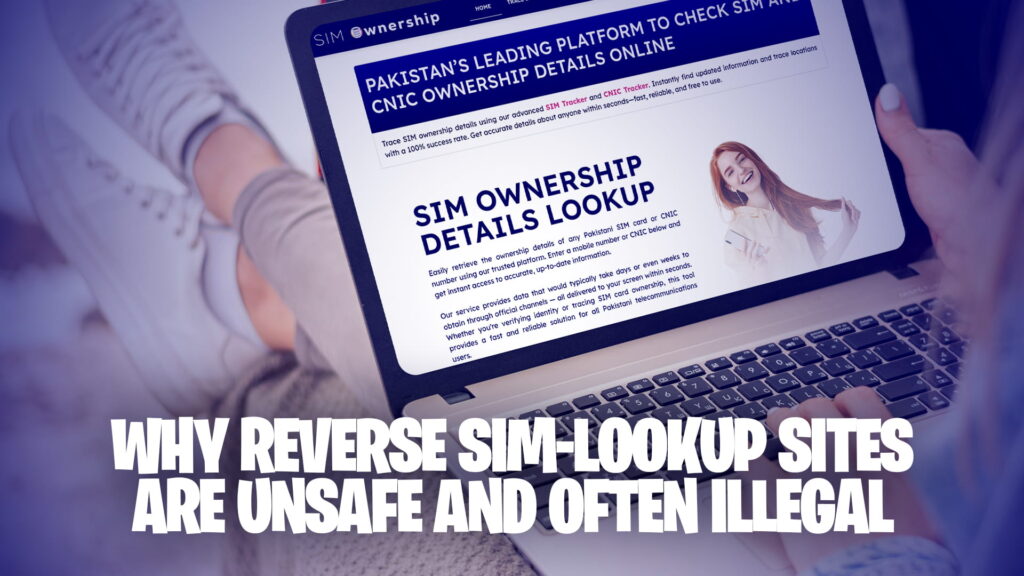
Type “trace mobile number owner” or “SIM database Pakistan” into any search box and you will find dozens of sites promising the full name, CNIC, and address behind any number for a small fee. They look convenient, and the temptation is real when an unknown number keeps calling. But most of these reverse SIM-lookup sites are built on stolen data, put your own privacy at risk, and can land you in legal trouble under Pakistani law.
This post explains how these sites actually operate, why they are dangerous, what the law says, and the safe and lawful ways to verify a SIM or CNIC when you have a genuine reason to.
What a Reverse SIM-Lookup Site Claims to Do
A reverse SIM lookup flips the usual direction of a search. Instead of finding a number for a person, you enter a phone number and ask the site to tell you who owns it. The pitch is appealing: catch a prank caller, identify a blackmailer, or check a buyer before a deal.
The problem is the source. In Pakistan, the link between a SIM and a person’s identity lives inside NADRA’s biometric system and the operators’ protected records. That information is private by law. A random website has no lawful access to it. So when a site claims to reveal full owner details on demand, it is either making the data up or working from a database that was leaked or stolen in the first place.
How These Sites Really Get Their Data
Understanding where the data comes from removes most of the temptation to use it.
Some sites simply fabricate results. They show a plausible-looking name and address that has no connection to the real owner, banking on the fact that you cannot easily check.
Others rely on old data breaches. Over the years, batches of subscriber records have leaked from various sources, and these stale dumps get recycled, repackaged, and sold again and again. The details are frequently outdated or wrong, and they were illegal to hold from the moment they leaked.
A third group harvests you. The number, CNIC, or payment details you type into the lookup box become the product. Your query is logged, your card information may be skimmed, and your device can pick up malware from the page itself. You arrive hoping to investigate someone and leave as the one whose data has been collected.
None of these sources is legitimate, and none gives you a result you could actually rely on or use.
The Legal Risk: PECA 2016
This is the part most people overlook. In Pakistan, accessing another person’s SIM or CNIC information without authorisation is a criminal offence under the Prevention of Electronic Crimes Act (PECA) 2016. The penalties run to imprisonment of up to three years and fines reaching one million rupees.
That liability does not sit only with the site operator. Knowingly using an illegal database to pull up a stranger’s private details can expose the user as well. Running such a “SIM database” service is treated as cybercrime, and any result you obtain through it has no legal standing. You could not present it as evidence, because it was gathered unlawfully in the first place. For a deeper look at how the legal verification framework works, the site’s FAQ explains what is and is not permitted.
So the trade-off is stark. You risk a criminal record and a heavy fine to obtain information that is probably fake, definitely outdated, or both.
The Privacy and Security Dangers
Even setting the law aside, these sites are simply unsafe to touch.
They routinely ask for payment through unsecured gateways, which means your card details flow to people who deal in stolen data for a living. Many pages carry hidden scripts that attempt to install spyware or redirect you to phishing forms. Some demand that you enter your own CNIC to “unlock” a result, quietly adding you to the very breach economy you were trying to escape.
There is also the matter of what you would be enabling if the data were real. The same lookup that lets you identify a caller lets a stalker find a victim or a fraudster profile a target. A system with no consent and no checks protects no one, and you have no way of knowing which side of it you are feeding. If guarding your personal information matters to you, it is worth reading how legitimate services handle data in their privacy policy rather than handing it to an anonymous lookup page.
The Safe and Legal Ways to Check a SIM or CNIC
There are genuine, lawful reasons to verify SIM information, mainly to protect your own identity. The key principle is simple: you may check what is registered against your own CNIC and verify a SIM you physically hold, but you cannot pull a stranger’s private details. Here is how to stay on the right side of that line.
Check the SIMs on your own CNIC. Send your 13-digit CNIC by SMS to 668, or use the official portal at cnic.sims.pk, to see every SIM registered in your name across all networks. This is the single best habit for catching unauthorised registrations early. The check SIM ownership and registration details guide walks through reading the result.
Verify a SIM you actually own. The code 667 lets you confirm the registered owner details of a SIM in your possession, which is useful when buying a used number or confirming your own line.
Use official operator channels. Jazz, Zong, Telenor, Ufone, and SCO each offer verification through their helplines and franchises, with biometric confirmation for anything sensitive.
Identify the network, not the person. For an unknown caller, you can lawfully check which operator a number belongs to without exposing private owner data. Resources like the SIM Information page and the NADRA CNIC details overview explain what can be checked openly and what stays protected.
If your real worry is a harassing or fraudulent caller, the right move is not a shady lookup but an official complaint. Report it to PTA or to the cybercrime authorities, who do have lawful access to trace a number through proper process.
How to Spot an Illegal Lookup Site
A few signals give these sites away. Be cautious of any service that promises instant full owner details for any number, charges a fee for “premium” CNIC data, asks you to enter your own CNIC to see results, or has no clear legal basis, privacy policy, or company information. Every legitimate verification method in Pakistan is free and routes through official channels. If a site is selling private data, that is the clearest sign it should not be trusted.
Looking up another person’s SIM or CNIC details without authorisation is illegal under PECA 2016, and many lookup sites operate on stolen data, which makes them unlawful. You may legally check the SIMs on your own CNIC and verify a SIM you physically hold through official channels.
You cannot lawfully obtain a stranger’s private owner details, free or paid. You can check which network a number belongs to and, for your own SIMs, confirm registration through 668, 667, and cnic.sims.pk. For a harassing number, file a complaint with PTA or the cybercrime authorities instead.
Most reverse-lookup databases rely on old, leaked records or simply fabricate names and addresses. The information is frequently outdated or invented, so it is unreliable and cannot be used for anything official.
You may break the law under PECA 2016, expose your card and CNIC details to data thieves, pick up malware, and receive false information. The supposed convenience is not worth the legal and security cost.
Use only official methods: SMS your CNIC to 668 to see SIMs registered in your name, use 667 to verify a SIM you own, check cnic.sims.pk, or visit your operator’s franchise. These are free, lawful, and accurate.
Do not use an illegal lookup. Save the evidence, then report the number to PTA or to the cybercrime authorities through their official complaint channels, since they can trace it lawfully and act on it.
Final Thoughts
Reverse SIM-lookup sites sell a shortcut that does not really exist. The data is usually stolen or fake, the page may infect your device or harvest your details, and the act of using it can break the law. When you have a genuine need, the lawful path is straightforward: check your own registrations through 668 and cnic.sims.pk, verify SIMs you hold, and let the official authorities handle anyone misusing a number. It is safer, it is free, and it is the only version that actually holds up.